
When is it worth challenging a parking fine?
Information in the AI's answer must be checked before use.
Give an overview of the circumstances in which private parking operators have lost disputes over penalties, and why. When is it worth challenging a penalty?
When has a private car park operator lost a “penalty dispute”?
It is worth challenging a penalty above all when you can identify a specific defect in the basis of the claim: the parking terms or the boundaries of the area were unclear, parking had effectively been paid for, the claim was made against the wrong person, notice of the penalty was not given in time, or the claim is time-barred. Sometimes the realistic aim is not to have the entire penalty set aside, but to reduce it and the additional costs.
By contrast, merely saying “I did not sign a contract”, “the car park suffered no loss” or “I was not driving” is generally not a sufficient defence.
Below, I discuss 14 separate court cases in which the operator’s claim was dismissed in full or in part, along with important counterexamples. This overview is current as at 05.10.2026. An individual County Court decision does not guarantee the same outcome in another dispute; where possible, I also set out the outcome of any subsequent appeal.
1. The legal starting point: what must the operator prove?
A private car park “fine” is usually a contractual penalty, not a state-imposed sanction. It must have a basis in the parking contract. VÕS § 158 subsection 1.
A parking contract can also be concluded by conduct — for example, by parking in a car park on clearly displayed terms. The absence of a signature therefore does not, in itself, make the claim unfounded. What matters is whether the contract and its terms were actually agreed upon. VÕS § 9 subsection 1; VÕS § 20 subsection 1.
In a dispute, the following questions must be distinguished:
- Was a contract concluded with the person against whom the claim is made? The owner of the car and the person who actually parked it may not be the same person.
- Did the parking terms become part of the contract? The terms must be clearly referred to, and the driver must have a reasonable opportunity to learn their content. An unusual term, or one that cannot be understood without considerable effort, may be excluded from the contract. VÕS § 37 subsections 1 and 3.
- Was the specific term breached? For example, failure to pay the parking fee, failure to display a permit and parking outside a parking space must be distinguished.
- Was notice of the demand for a contractual penalty given within a reasonable time? Otherwise, the operator may lose the right to claim it. VÕS § 159 subsection 2.
- Are the penalty term and the amount claimed valid and reasonable? An unreasonable standard term may be void; a valid penalty that is excessive in the particular circumstances can be reduced. These are different objections. VÕS § 42 subsection 1 and subsection 3 clause 5; VÕS § 162 subsection 1.
As a general rule, each party must prove the facts on which its claims and objections are based. Case law has clarified this burden in relation to the owner and the actual driver. TsMS § 230 subsection 1.
First check the type of claim. The same private company may also carry out parking enforcement for a local authority. The company’s name alone does not tell you whether the claim concerns a private-law contractual penalty or a public-law excess parking charge. Nor is the 15-minute free period for local-authority paid parking a general rule for private car parks. LS § 187 subsections 3–4.
2. Cases in which the operator lost in full or in part
A. Unclear signs, car park boundaries or parking-space markings
1. The parking prohibition and the offer of a contract were contradictory
Viru County Court, 16.02.2026 — 2-25-107509/16, especially points 5–8.
The operator claimed €20 as the outstanding balance of a contractual penalty, €3.98 in default interest, €30 in recovery costs and further default interest from the person who parked. At the entrance, there was a parking-prohibition zone sign allowing an exception for parking with the permission of the person in possession of the premises, a “private car park” sign beneath it, and parking terms beside it.
The court found that:
- the terms were not legible in the photographs submitted;
- the separately submitted terms did not allow verification that the same terms had been displayed on site;
- in these circumstances, the combination of a parking prohibition and the alleged offer of a parking contract was contradictory.
Outcome: the entire claim was dismissed. The operator bore the legal costs; no costs were awarded to the person who parked.
Lesson: there may be strong grounds for a challenge if the signage does not make clear what service is being offered and to whom. However, this decision does not mean that every prohibition sign permitting parking with a permit precludes a parking contract.
2. The boundary between the car park and the grassed area was misleadingly marked
Tartu County Court, 03.05.2022 — 2-22-999/7, especially points 3–6.
The car’s right-hand wheels were on the grassed area, and the operator claimed a €30 contractual penalty. The edge of the car park was overgrown with grass, and the boundary was indistinct. Marker posts stood at the edge of the grassed area, and the car was on the car park side of them.
The court found that the driver was entitled to rely on the markers installed by the operator. If the markings did not fulfil their intended function, the operator had to choose a clearer way of marking the area. In the court’s assessment, the driver had not breached the parking terms.
Outcome: the court declared that there was no obligation to pay €30 and ordered the operator to pay the person who parked €185 in pre-litigation legal assistance costs and €150 in legal costs.
Lesson: the actual markings of a parking space may carry more weight than the operator’s subsequent explanation of where the boundary “was supposed to be”. Nor must the person who parked submit endlessly repeated objections before obtaining justified legal assistance.
3. The alleged pavement was not clearly distinguished from the parking area
Harju County Court, 10.08.2021 — 2-21-5720/8, especially points 12–17.
The operator justified a €40 contractual penalty on the ground that the car was parked outside the parking spaces, allegedly on a pavement. The person who parked had already paid the penalty but had obtained a decision in their favour from the Consumer Disputes Committee. The operator then brought the matter before the court.
The photographs did not show a clearly delineated pavement or markings prohibiting parking in the disputed location. The court regarded the location as part of the parking area and found that the person who parked had not breached the operator’s terms.
Outcome: the operator’s action was dismissed, and it bore the legal costs. However, the operative part of the judgment did not order repayment of the €40 already paid — that outcome must not be assumed.
Lesson: inadequate markings may defeat a claim even if the operator calls the location a pavement. Success on the question of whether the claim is unfounded and recovery of money already paid may need to be addressed separately.
B. Payment for parking and issuing a penalty too quickly
4. A one-digit entry error: the penalty was reduced to zero
Harju County Court, 30.11.2023 — 2-23-124789/18, especially points 19–25 and 29–33; subsequent order of Tallinn Circuit Court of 23.01.2024 — 2-23-124789/19, points 10–14.
The person who parked paid €3.75 for mobile parking but entered one digit incorrectly. The operator claimed a €30 contractual penalty and €15 in recovery costs.
The County Court did not deny the formal breach: parking had not been registered for the correct vehicle. At the same time, it was plausible that this was human error. The vehicle whose registration number had been entered by mistake was not connected to the person who parked, and the operator had received the fee and had not refunded it.
Outcome: the contractual penalty was reduced from €30 to €0, and the €15 claim for additional costs was also dismissed. Each party bore its own costs in the County Court. The Circuit Court refused to admit the operator’s appeal and agreed with the outcome.
In relation to the additional costs, the court also considered it important that the operator itself had used the wrong parking date in its reminder and its application for a payment order.
Lesson: it is worth challenging a penalty arising from a registration-number error if the payment, time, car park and actual intention to park can be proved. This does not mean that every payment made under the wrong registration number automatically exempts the person from a penalty.
5. The person who parked immediately went to buy a ticket: €3 instead of €30
Tartu County Court, 16.03.2022 — 2-21-20246/10, the reasoning section “The court’s position and reasons”; the reasons are unnumbered.
Immediately after parking the car, the person who parked went to buy a ticket from the parking machine. Payment was made within approximately 1–2 minutes, but a €30 contractual penalty was issued in the meantime.
The court found that the formal requirements for the claim were met: when the penalty was issued, the start of parking had not been indicated and the fee had not been paid. However, the breach was very minor, and there was no evidence that the driver intended to avoid payment.
Outcome: the penalty was reduced to €3; the claim was dismissed to the extent of €27. The person who parked was also ordered to pay €7.50 in legal costs, making a total of €10.50.
Lesson: the time spent immediately buying a ticket may support a substantial reduction. In this case, however, it did not result in complete exemption.
6. Two minutes was not enough to familiarise oneself with unclear terms — and someone else had parked the car
Tartu County Court, 20.05.2026 — 2-25-114842/9, points 8.1–9.2; Tartu Circuit Court, 30.07.2026 — 2-25-114842/12, points 9–10.
A car was parked beside a petrol station at 10.55, and a €55 contractual penalty was issued at 10.57. A parking disc was visible. The driver had relied on the free-parking arrangements for the adjacent area.
The operator lost for two separate reasons:
- the owner proved, through a call log and earlier correspondence, that their spouse had parked the car;
- the differences between the parking areas and their terms had not been proved sufficiently clearly, and in this particular car park two minutes was not a reasonable time to familiarise oneself with the terms.
Outcome: the €55 claim was dismissed in full. The Circuit Court refused to admit the operator’s appeal. The operator bore the legal costs, but no separate reimbursement of costs was awarded to the person who parked.
Lesson: issuing a penalty too quickly may be open to challenge, especially where parking arrangements are complicated or misleading. This decision does not establish a general two-minute free period in private car parks.
C. The claim was made against the wrong person, or there was no contract with that person
7. The operator did not even prove who owned the car at the time of parking
Harju County Court, 30.04.2026 — 2-25-128096/13, especially points 7–11.
For two instances of parking, the operator claimed €80 in contractual penalties, €26.92 in accrued default interest and further default interest. The person against whom the claim was made argued, among other things, that the car had previously been sold.
The operator’s registry extracts were unclear, difficult to read and of unverifiable origin. The court drew attention to the deficiency, but additional evidence was submitted late and was not admitted.
It was therefore not proved that the defendant was the owner or registered responsible user at the time of parking. Only once that connection has been established can the question arise whether that person must prove that someone else was driving.
Outcome: neither the €80 penalty, the €26.92 in default interest nor further default interest was awarded. The operator bore the costs; there were no costs to reimburse.
Lesson: if a claim concerns parking after the car was sold, submit the sale and handover documents immediately. This decision does not mean that an electronic registry extract is always unsuitable — the deficiencies concerned the specific piece of evidence.
8. A company’s management board member could not automatically be treated as the person who parked
Tallinn Circuit Court, 31.01.2020 — 2-18-118623/29, especially points 19–22.
The operator claimed a total of €300 from an individual for ten instances of parking. However, the car’s registered responsible user was a company. The defendant was a shareholder and management board member of the company, was listed in the registry as one of the car’s users and had collected the car after it was towed away.
The County Court considered these connections sufficient and awarded €300 and €75 in legal costs. The Circuit Court set aside the judgment: the presumption applicable to an owner or registered responsible user did not automatically extend to this individual. It had not been proved that this person had actually parked the car.
Outcome: the €300 claim was dismissed in full. The operator bore the costs of both court instances; their monetary amount was to be determined later.
Lesson: a connection with a company using a car does not equate to personal contractual liability.
9. The occupier of an apartment already had a statutory right to park
Supreme Court, 21.02.2024 — 2-22-100795/12, especially point 12 and points 13.1–13.4.
The operator claimed a €30 contractual penalty and €10 in recovery costs because no parking card was displayed on the car’s dashboard. The defendant used the apartment ownership as the owner’s spouse and had a statutory right to use the parking area.
The Supreme Court agreed that, in such circumstances, merely parking cannot automatically be taken to indicate an intention to conclude a separate parking contract with the operator.
The important clarification was as follows:
- the choice of operator and the parking-card system may be decided by a majority vote as part of ordinary management;
- however, making an apartment owner’s existing right of use dependent on a parking card requires an agreement between the apartment owners.
Outcome: the operator’s appeal was dismissed, and the dismissal of the entire €40 claim remained in force. There were no reimbursable costs at the cassation stage.
Lesson: this is a strong objection for an apartment-building resident who has an existing right to use the common property. It does not invalidate all apartment associations’ parking-card systems. The legal basis is KrtS § 30 subsection 1 clause 2 and subsection 3, together with KrtS § 13 and § 35 subsection 1.
D. Notice of the penalty and limitation periods
10. Placing the notice under the windscreen wiper was not proved; the first proven notice came years later
Tallinn Circuit Court, 28.05.2021 — 2-19-136882/16, especially points 29–31.
For two instances of parking in 2016–2017, the operator claimed €80 in contractual penalties and €30 in recovery costs. The County Court allowed the claim.
The Circuit Court agreed that a parking contract had been concluded. The operator’s defeat therefore did not result from the absence of a contract, but from failure to prove notification:
- the photographs did not show penalty notices under the windscreen wipers;
- the assertion “we always leave them there” did not prove delivery in the specific cases;
- the first proven notification was the payment-order proceedings in 2020.
A delay of several years was not reasonable in this relationship, and the operator lost the right to claim the contractual penalties.
Outcome: the entire €110 claim was dismissed. The operator bore the costs of the County Court and Circuit Court proceedings; their monetary amount was to be determined later.
Lesson: what matters is not just whether you remember the notice, but whether the operator proves that it was properly delivered.
11. Driving into the area was not parking under the contract, and photographing the car was not notice of a penalty
Harju County Court, 29.03.2022 — 2-21-20482/6; Tallinn Circuit Court, 06.05.2022 — 2-21-20482/8, especially points 28–31.
A driver drove into an area with restricted access beside a terminal, remained in the car and left. An enforcement officer photographed the car. The operator later claimed a €41 contractual penalty and €15 in recovery costs.
The courts identified several deficiencies:
- the operator’s own terms linked the contract to parking, not merely driving into the area;
- the operator acknowledged that the driver had not parked;
- the visibility of the terms on site at the time had not been proved;
- taking photographs did not prove delivery of the penalty notice.
The first proven notice arrived more than 2.5 years later.
Outcome: the entire €56 claim was dismissed, and the operator was ordered to pay the person who parked €288 in representation costs, plus default interest on those costs. The appeal was not admitted.
Lesson: check what conduct concludes the contract and what breach the penalty covers. Breaching a traffic sign does not, in itself, give rise to a contractual penalty claim if there is no corresponding contractual basis.
12. The three-year limitation period had expired by the time the court proceedings were initiated
Harju County Court, 30.06.2023 — 2-22-141517/11, especially points 24–27.
For two instances of parking in 2019, the operator claimed €70 in contractual penalties, €20.58 in default interest, €20 in recovery costs and further default interest.
The court found that the contract and the breach had been proved. However, the claims became time-barred in March and April 2022, calculated from the deadlines for paying the penalties. The application for a payment order was not submitted until 01.11.2022.
The court did not agree with the operator that the limitation period for a contractual penalty should begin only at the end of the year in which the parking occurred.
Outcome: the entire fixed-sum claim of €110.58, as well as the claim for further default interest, was dismissed. The operator bore the costs; the defendant had no reimbursable costs.
Lesson: the limitation period for a contractual penalty must not automatically be calculated in the same way as for an ordinary claim for an agreed parking fee. The general rule is three years from the date the claim becomes due. You must invoke the limitation period yourself. TsÜS § 146 subsection 1; § 147 subsections 1–2; § 143.
E. A void penalty term, reduction and additional costs
13. An unreasonable “up to €60” term and an unproved parking location
Tallinn Circuit Court, 02.05.2017 — 2-16-123200/26, especially point 38 and points 45–59.
The operator claimed €240 for ten instances of parking. In two car parks, a standard term allowed the operator to impose a penalty of up to €60 at its discretion. In one of these, four hours were free, after which the fee was €0.30 per half-hour; in the other, no parking fee was stipulated.
The Circuit Court found that:
- for two instances of parking, the alleged location had not been proved — €40 of the claim was dismissed;
- in the circumstances, the sanction of up to €60 in the car parks described was unreasonable, and the €50 claimed under that term was dismissed.
The fact that less than the maximum amount was actually claimed did not make the term reasonable. A void term could not simply be reinterpreted into an acceptable one.
Outcome: €150 was awarded instead of €240. A subsequent costs order confirms that the judgment became final; after the costs were set off, the operator had to pay the person who parked €96.60 and default interest. Tallinn Circuit Court order of 04.01.2018, 2-16-123200/41.
Lesson: the penalty term itself can also be challenged. However, this older decision does not mean that a €60 penalty is void in every car park or that there is a fixed permissible multiplier of the parking fee for a penalty.
14. Exceeding the free period by 11 minutes: a small reduction, but additional costs were disallowed
Harju County Court, 03.12.2024 — 2-24-117207/18, especially points 10–13 and 15.
The start of parking was indicated with a parking disc, but the free period had been exceeded by 11 minutes. The operator claimed a €40 penalty, €11.97 in default interest and €30 in recovery costs.
The court did not agree to complete exemption. The person who parked had partly fulfilled the obligation, and the breach was minor, so the penalty was reduced to €35.
The greater financial gain came from the additional costs: the operator did not sufficiently prove the costs of the alleged recovery actions or the basis for reimbursing them. The statutory €30 limit did not constitute an automatic fee.
Outcome: €45.47 was awarded, comprising a €35 penalty and €10.47 in default interest. Further default interest was also awarded in this case up to €24.53. The claims for €5 of the penalty, €1.50 in default interest and the entire €30 in additional costs were dismissed. Each party bore its own legal costs.
The driver’s €1,790 damages claim against a third party was not admitted as a counterclaim.
Lesson: a minor overstay does not provide automatic exemption. Sometimes the strongest objection concerns the additional costs rather than the penalty itself.
3. What common conclusions can be drawn from these decisions?
3.1. A specific, provable objection is the strongest
“The penalty is unfair” is much weaker than, for example:
- “There were no terms displayed at this entrance; here are photographs from the day of the incident.”
- “I paid for this parking; here are the text message and payment records.”
- “The car had been sold before the parking occurred; here are the handover documents.”
- “Someone else parked the car; here is a statement concerning the specific period when they used it.”
- “The photographs do not show delivery of the penalty notice, and the first proven notice arrived years later.”
At the same time, unrealistic evidence cannot be demanded from the operator. The Supreme Court has explained that, as a general rule, a photograph of an identifiable car together with the time and place stated on the penalty notice may suffice to prove parking; the person who parked can submit evidence to the contrary. This was explained in a dispute whose final outcome required the detained car to be returned against payment or deposit of €30, with the person who parked bearing the legal costs. Supreme Court judgment of 06.12.2017, 2-15-3430/58, especially point 18.
Thus, the car, all the signs and the entire car park do not have to appear in a single photograph.
3.2. Payment helps, but does not eliminate every breach
Payment of the parking fee may support a reduction of the penalty, as in the registration-number error case. However, a separate term may require the correct registration number, electronic registration of parking or visible display of a permit.
Nor does the absence of loss alone preclude a contractual penalty. A contractual penalty may serve to encourage performance of an obligation. VÕS § 161 subsection 1.
Depending on the agreement, the parking fee and contractual penalty may also be claimed together — there is no general rule that an operator who has received the fee can never claim a penalty as well. VÕS § 159 subsection 1.
3.3. “I was not driving” requires actual evidence
Counterexample: an owner proved through airline tickets that they were abroad but did not show who had parked the car. The car could have been parked before the trip. The Circuit Court reversed the County Court’s decision against the operator and awarded a €30 penalty and €1.50 in recovery costs, leaving the owner to bear the legal costs. Tallinn Circuit Court judgment of 23.08.2024, 2-22-104500/29, points 18–27.
The Supreme Court has also emphasised timely submission of evidence. In a claim against a car rental company for a €75 penalty and €15 in additional costs, details of other drivers had been provided before the court proceedings, but a digitally signed statement from the driver confirming exclusive use was only submitted with the defence to the action. The names were an assertion, whereas the statement was evidence.
In that case, each party bore its own costs incurred up to the replacement of the original defendant; the owner was not reimbursed for its €1,416.42 in representation costs in the Supreme Court. The Supreme Court explained that late evidence may justify making the owner bear the operator’s costs. Supreme Court order of 11.09.2024, 2-22-130552/18, points 14.1–17.
Conclusion: submit evidence of the actual driver with your very first objection, not only once the matter reaches court.
3.4. Notification and limitation periods are different
A distinction must be made between:
- giving notice of the penalty claim within a reasonable time;
- the limitation period for bringing the claim before a court.
A late reminder does not prove that the initial notification was late.
Counterexample: in a dispute over eleven penalties totalling €330, the Supreme Court found that placing a notice under the windscreen wiper may be a reasonable method of notification even if the operator knows the owner’s contact details. Following reconsideration, the €330 claim was upheld, and the person who parked was also ordered to pay €1,200 in costs of the cassation proceedings. The notices were visible in the photographs. Supreme Court judgment of 05.06.2019, 2-17-117146/31, points 12–13; Tallinn Circuit Court judgment of 30.10.2019, 2-17-117146/42, points 14.4–14.7.
Thus, “I did not receive the paper notice” may not help if reasonable delivery has been proved.
For limitation purposes, timely filing of an action or an application for a payment order may suspend the limitation period. Acknowledging the claim, including by partial payment, may interrupt the limitation period. TsÜS § 160 subsection 1 and subsection 2 clause 3; § 158 subsections 1–2.
3.5. Unclear markings do not create a general right to park improperly
Compare the grassed-area case described above with another decision: one wheel of a repair company’s lorry was over the kerb on a grassed area. There was a general parking permit, but permission to park on the grassed area was not proved, and the boundary was clear.
The court dismissed the action seeking a declaration that the €55 contractual penalty was unfounded. The person who parked bore the legal costs, but their monetary amount was not determined. Tartu County Court judgment of 28.05.2026, 2-25-7902/12, points 10–15.
Conclusion: the actual markings, the scope of the permission granted and the content of the contract are decisive — not merely the assertion “I had a parking permit”.
4. When is it worth objecting?
| Situation | Realistic aim |
|---|---|
| The terms were hidden, illegible or contradictory | Defeating the entire claim, if the defect can be proved |
| The boundary of the car park or parking space was misleading | Proving that there was no breach |
| The fee had been paid, but there was a provable registration-number error | Substantial reduction or cancellation of the penalty; not an automatic outcome |
| The penalty was issued immediately while a ticket was being bought or the terms were being read | Reduction or dismissal of the claim, depending on the circumstances |
| The car had been sold, or someone else demonstrably parked it | Dismissal of the claim against you |
| The occupier of an apartment already had a statutory right to park | Examination of the basis for a separate parking contract and sanction |
| The initial penalty notice is unproved or was substantially delayed | An objection that the right to claim the contractual penalty has been lost |
| The three-year limitation period expired before court proceedings were initiated | A request to apply the limitation period |
| Unjustified debt-collection or processing fees have been added | Removal of additional costs even if the penalty itself is valid |
Weaker objections include merely relying on the absence of a signature, not knowing the driver’s identity, an unproved assertion of payment, general dissatisfaction with the amount of the penalty or the mistaken belief that private car parks always allow 15 minutes free.
For consumer debt-recovery costs, the statutory amounts are caps, not automatic surcharges. For a claim of up to €500, the general limit after the contract has ended is €30, but the specific basis, actions taken and other conditions must be checked. The automatic €40 compensation applicable between businesses does not apply to consumers. VÕS § 113² subsections 2–6; VÕS § 113¹ subsection 4.
5. What practical steps should you take?
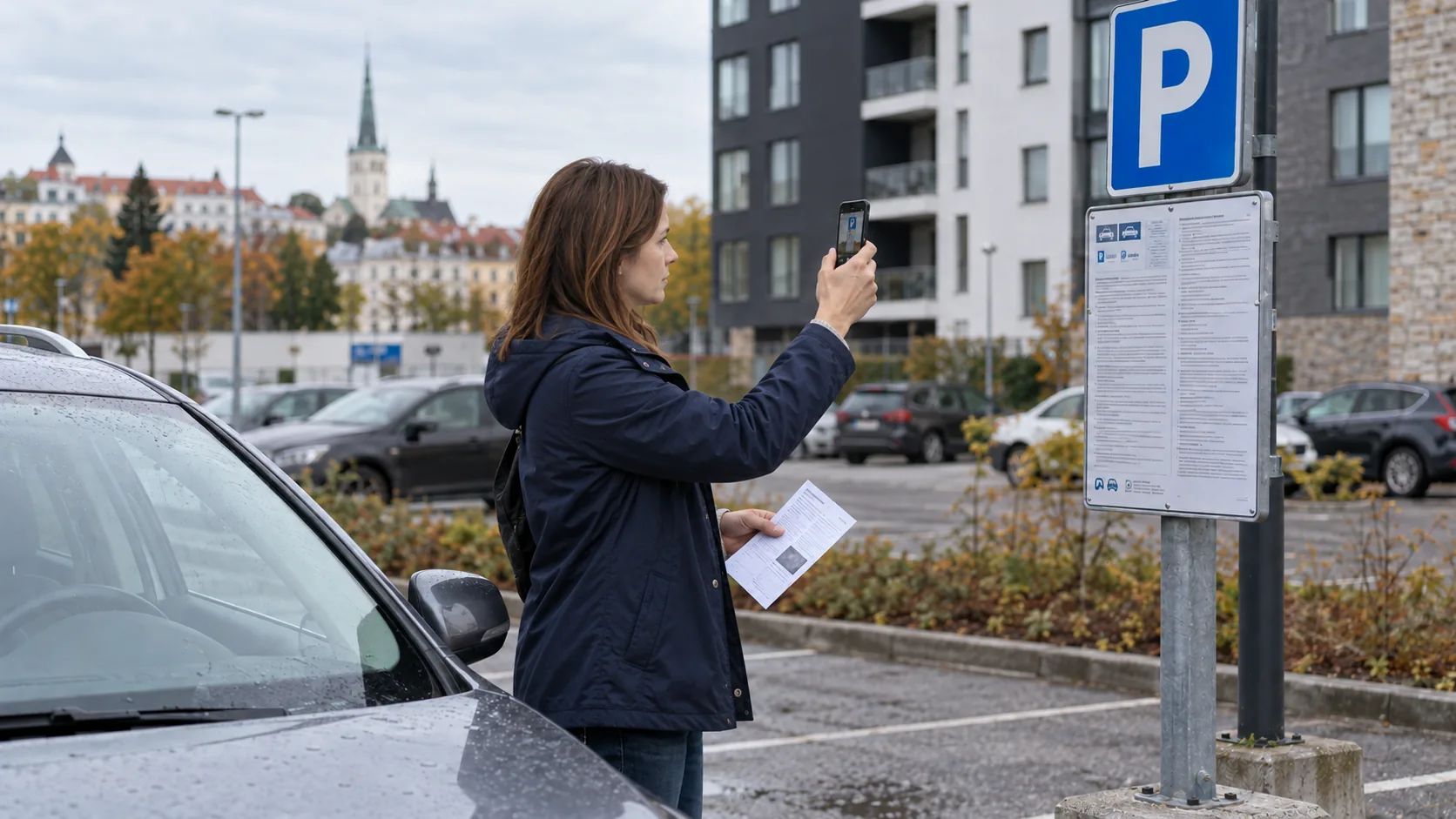
1. Preserve evidence immediately
Take photographs of:
- the entrance used, from the driver’s perspective;
- the location and legibility of the information board;
- the car’s position, the lines and the car park boundaries;
- the parking disc, permit or ticket.
Keep text messages, the parking history in the app, payment records and correspondence. In the case of a registration-number error, show which parking you actually paid for.
2. Submit a specific written objection to the operator
If necessary, ask for:
- the terms in force at the time of the incident and evidence of their visibility on site;
- photographs proving the breach and delivery of the penalty notice;
- an explanation of why the claim is being made specifically against you;
- a calculation of default interest and recovery costs.
A suitable basic structure is:
I dispute the contractual penalty claim. The reason is [specific circumstance], as proved by the attached documents. Please withdraw the claim. If you nevertheless consider the claim justified, please provide its contractual and evidential basis. Alternatively, I request a reduction of the contractual penalty because [the minor extent of the breach or substantive performance of the obligation].
Rely only on the actual facts, rather than raising every possible objection at once.
3. As a consumer, use the free committee procedure if necessary
A trader must generally respond to a written complaint within 15 days; if a delay is justified, a new reasonable deadline must be set. Failure to respond does not automatically cancel the penalty. TKS § 24 subsections 5–9.
After contacting the operator, a consumer can submit an application to the Consumer Disputes Committee. The procedure is free, but the committee’s decision is not enforceable, and the same dispute may continue in court. Businesses cannot use this consumer procedure. TTJA guidance on submitting an application; TTJA explanations of the committee procedure.
4. Do not ignore documents received from the court
An objection submitted to the operator is not a substitute for responding to the court.
An objection to a proposal for payment in payment-order proceedings must generally be submitted within 15 days if served in Estonia; if served abroad, the deadline is 30 days. At this stage of the proceedings, the objection does not have to state reasons. TsMS § 485 subsections 1–2.
5. Also assess the risk of costs and the effect of payment
In court, the losing party generally bears the costs; in the event of partial success, the allocation may differ. Necessary and justified representation costs are reimbursed, not necessarily the lawyer’s entire bill. TsMS § 162 subsection 1; § 163 subsection 1; § 175 subsection 1.
Once a contractual penalty has been paid, you can no longer demand its reduction. If the obligation paid did not actually exist, there may nevertheless be a claim to recover an unjustified payment — that is a different legal question. VÕS § 162 subsection 3; § 1028 subsection 1.
Conclusion
It is most worthwhile to object when you have evidence of a specific defect in the claim. The more successful grounds have included unclear markings, an unproved contract or breach, a claim against the wrong person, late notification and expiry of the limitation period.
If a breach actually occurred, it may still be justified to seek a reduction of the penalty and removal of additional costs. For a small penalty, it is usually sensible to start with an evidence-backed written objection and the free Consumer Disputes Committee procedure, rather than costly litigation.
Information in the AI's answer must be checked before use.
More articles

The engine in a used car broke down — who pays?
Is the seller responsible for an engine that fails a month after purchase? Case law shows why the seller's status, technical evidence, and the repair procedure matter.

Damages awarded for insults
I called someone a fraud on Facebook. Could that lead to a claim for damages?